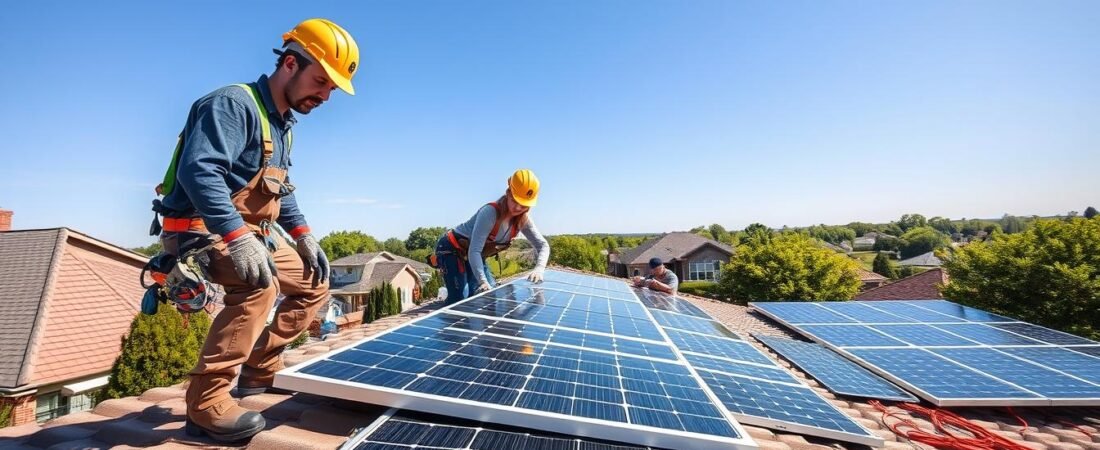
Finding dependable solar installers for your home starts with local expertise and clear ratings. Our guide focuses on trustworthy teams who deliver quality installation, long-term service, and help you access the 30% federal tax credit. We also highlight options for solar loans and flexible financing.
Choosing the right solar company means checking workmanship, warranties, and customer feedback. We compare the best solar companies by rating and track record so you can pick a partner who knows local roofs and energy needs.
Expect guidance on incentives, accurate estimates for your solar system, and support after the install. Our list of installers mckinney points you to professionals who make the switch to clean energy smooth and reliable.
Reliable Solar Panel Installers Serving McKinney, TX
Start local. Look for crews that know permit timelines, neighborhood code quirks, and roof types. That local edge speeds approvals and reduces surprises during install.
We vetted a shortlist of trusted teams to help you avoid common pitfalls. Each provider on our list shows clear contracts, strong communication, and a record of timely work.
When you compare options, check for a stable local presence and positive homeowner feedback. These traits point to good follow-up service and faster warranties claims.
- Committed to quality workmanship and customer care
- Experienced with local permits and grid hookups
- Transparent pricing and post-install support
| Provider | Local Office | Typical Warranty | Notable Strength |
|---|---|---|---|
| BrightHome Energy | McKinney area | 10 years workmanship | Fast permitting |
| Sunline Installers | Nearby suburb | 12 years workmanship | Customer support |
| GreenGrid Services | Regional hub | 15 years workmanship | Design optimization |
| HomeEnergy Pros | Local branch | 10 years workmanship | Flexible financing |
How to Evaluate Solar Panel Companies McKinney TX
Quality checks make the difference between a smooth switch to cleaner energy and months of headaches. Start with clear, measurable items so you can compare firms fairly.
Years in Business
Look for at least five years of operation. Firms that last tend to honor warranties and handle follow-up service reliably.
Longer tenure also means installers know how to size systems for a typical home and how much solar panels will produce on local roofs.
Customer Review Scores
Check the BBB rating and read reviews on Google and Yelp to see how customers describe customer service and installation timelines.
Compare offered equipment and production estimates. A reputable provider will explain system size and costs clearly so you can make a confident choice.
- Verify BBB score and recent reviews
- Ask for equipment specs and energy forecasts
- Demand transparent pricing and a written proposal
To research local options and find best solar installers, use a trusted review directory and confirm references before signing.
Essential Credentials for Your Solar Installer
Start by confirming that your chosen installer carries recognized certifications and solid insurance. This protects workers and your property during installation.
Make sure the team employs NABCEP certified professionals or licensed electricians.
- High BBB rating and current insurance to cover jobsite risks and liability.
- Ask about the specific equipment brands they install to gauge long-term performance.
- Request at least a ten-year labor warranty to show ongoing customer service commitment.
“A long warranty and clear certifications tell you the business stands behind its work.”
When comparing options, look for transparent contracts, steady ratings from past customers, and willingness to share references. A trustworthy solar company will discuss certifications and proof of insurance without hesitation.
Understanding Solar Financing and Payment Options
Before signing, learn how different financing choices change your upfront cost and lifetime savings. The right path depends on your budget, credit, and how long you plan to stay in the home.
Cash Purchases
Paying cash gives the best long-term return because you own the system outright and avoid interest or dealer fees. You also keep federal tax credits and all future savings on your energy bill.
Solar Loans and Dealer Fees
Many buyers use solar loans to spread costs. Ask if the loan includes dealer fees; these can add 15–25% to the total price of the solar system.
Compare APR, term length, and whether monthly payments offset estimated savings. A reputable solar company will show numbers that make this clear.
Leasing and Power Purchase Agreements
Leases and PPAs reduce upfront cost but mean you do not own the equipment. That can limit incentives and resale value.
- Confirm how a lease affects tax credits and maintenance responsibility.
- Check with your utility company about net metering rules; they affect payback time.
“Ask for a full cost breakdown so you can compare cash, loan, and lease offers side by side.”
Maximizing Savings with Local Incentives and Rebates
Local rebates and federal credits can cut your installation bill by thousands. The 30% federal tax credit applies when you buy solar panels or battery storage and reduces your overall cost directly.
AEP Texas also offers residential rebates up to $3,000 per system, tiered by size. Combining that rebate with the federal credit can lower your solar panels cost dramatically.
Plan like a small business owner: list every incentive, including state property tax exemptions that often protect your home value from higher assessments after installation.
- Use the federal tax credit to reduce upfront expense.
- Claim local utility company rebates, such as the AEP program, to save on installation fees.
- Stack state and local incentives to speed payback and boost solar savings.
“A professional installer will help you identify every rebate so you get the best return on your investment.”
Comparing Solar Quotes for Your Home
Start by checking how each bid sizes the system and forecasts yearly energy production. This shows which offer delivers the most savings over time.
Analyzing System Size and Energy Production
Compare cost per watt so you know if a quote is fair. In our area, $2.22–$3.32 per watt is typical; numbers outside that range deserve questions.
Get at least three quotes. Different builders may propose different system sizes. That affects annual energy and long-term solar savings.
- Use a solar calculator to verify production estimates.
- Ask the installer to show roof orientation and shading analysis.
- Request a clear breakdown of dealer fees if you consider solar loans.
- Check a high bbb rating as a sign of reliable quoting and service.
| Quote | Cost per watt | System size (kW) | Est. annual energy (kWh) | Dealer fees |
|---|---|---|---|---|
| Bid A | $2.25 | 6.5 | 9,100 | $0 |
| Bid B | $2.95 | 7.0 | 9,800 | $450 |
| Bid C | $3.10 | 6.0 | 8,400 | $300 |
“Getting multiple detailed quotes helps you spot the best value and avoid surprises.”
The Step by Step Solar Installation Journey
A clear timeline helps homeowners move from estimate to power generation with confidence.
First, the process begins with a home energy audit. This determines the best system size for your needs and avoids oversizing or undersizing the system.
Next, professional solar installers handle permitting. Permits keep work safe and compliant with local codes. Expect permit-to-connection to take about three months.
The actual roof installation is efficient. Crews typically finish mounting panels and wiring in roughly three days. Electric connections are tested to secure optimal energy performance.
After installation, the utility company inspects and authorizes grid connection. Only then can you start generating power and tracking output with a solar calculator.
- Look for teams with at least five years of experience and a strong bbb rating to reduce delays.
- Use per watt production numbers to verify promised performance.
“A stepwise process and clear deadlines protect your roof, wallet, and long-term output.”
| Step | Who | Typical time | Key note |
|---|---|---|---|
| Energy audit | Installer or assessor | 1 week | Defines system size and expected savings |
| Permitting | Solar installers (permit team) | 2–6 weeks | Ensures code compliance |
| Roof installation | Installation crew | ~3 days | Mount, wire, and test for safety |
| Inspection & grid hookup | Utility company | 1–4 weeks | Final approval before generating energy |
Why Local Installers Outperform National Chains
Choosing a nearby provider often means quicker response times and clearer accountability. Local teams answer calls fast and return to fix issues without long waits. That helps homeowners feel secure about their investment in clean energy.
Accountability and In-House Crews
In-house crews give consistent workmanship because the same team does estimate, installation, and follow-up. You can ask to meet technicians and confirm credentials before work begins.
Local businesses keep closer ties with customers and often maintain higher ratings for service and follow-through.
Knowledge of Local Regulations
Local contractors know permit rules and utility procedures. That local expertise often speeds approvals and avoids surprises that national chains may face when they rely on remote teams.
Pick a business with at least five years of local work and a strong bbb rating to cut delays and get better long-term service.
- Faster permitting and accurate code compliance.
- Personalized customer service from the same crew that installed your system.
- Higher local ratings due to reputation and repeat work.
“Local providers offer hands-on care and faster resolution when issues arise.”
| Advantage | Local Installer | National Chain | Why it matters |
|---|---|---|---|
| Accountability | In-house crews, direct contact | Often subcontracted | Faster fixes and consistent service |
| Permit speed | Familiar with county rules | Centralized permit teams | Reduces approval time |
| Customer rating | Higher local rating and trust | Mixed reviews by region | Better long-term support |
To learn more about our local approach, visit about our local team and see how we prioritize clear communication and lasting service.
Conclusion
Investing in a reliable installer ensures your home gets steady clean solar energy and long-term savings. Choose teams that show solid workmanship and transparent estimates so your system performs as promised.
Check the BBB rating and compare the cost per watt across multiple bids. That helps you spot fair pricing and avoid unexpected dealer fees when using solar loans.
Prioritize quality equipment, strong service, and installers who answer customers’ questions clearly. Doing so locks in the best solar savings and protects your tax credit benefits for years to come.