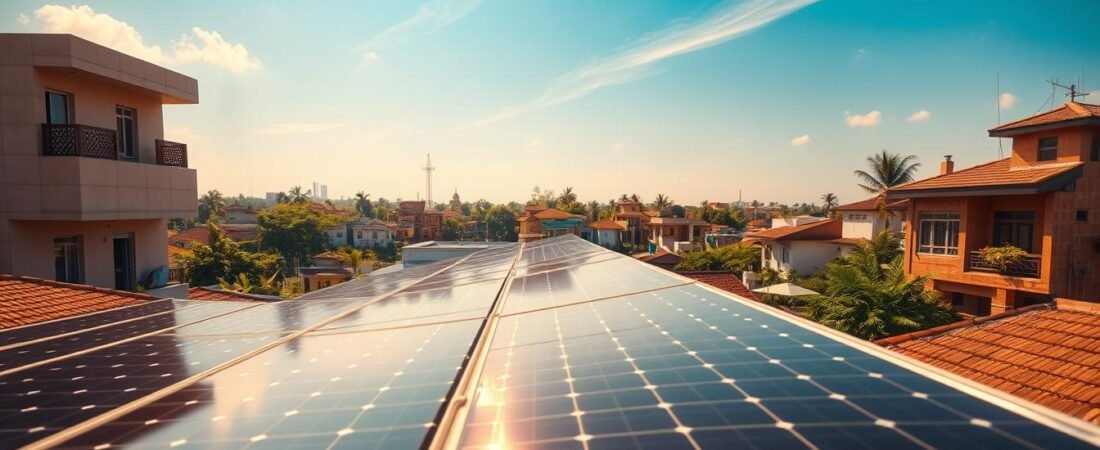
Thinking about a home system? As of 2026, the average cost to install a residential setup ranges from INR 1.5 lakh to INR 5 lakh or more.
This short guide helps you grasp the price drivers and the benefits of installing solar for long-term savings. Understanding the installation process makes budgeting easier and reduces surprises.
We cover key topics like government subsidy options, quality differences, and how a reputable company affects final price.
Whether you want a small rooftop array or a larger system, smart planning improves outcomes and boosts your returns. For a deeper breakdown and a practical cost chart, see our detailed installation guide.
Understanding the Basics of Home Solar Systems
Understanding the main parts of a home PV installation lets you make smarter decisions about capacity and performance.
A typical home solar system has a few core parts that work together to deliver clean electricity. At its heart are the solar panels, which capture sunlight and create DC current. An inverter then converts that DC into AC power for your home and grid.
Types of Solar Panels
Common types include Mono PERC, Polycrystalline, and thin-film. Mono PERC panels are more efficient and need fewer panels for the same output.
Polycrystalline panels cost less but require more rooftop area. The choice of type affects how many panels a system needs and the overall performance over time.
| Type | Efficiency | Typical Use |
|---|---|---|
| Mono PERC | High (18–22%) | Rooftops with limited space |
| Polycrystalline | Moderate (15–18%) | Budget-friendly residential arrays |
| Thin-Film | Lower (10–12%) | Large-area or flexible applications |
Role of Inverters
An inverter is essential. It manages the flow from a panel system and ensures appliances receive usable AC electricity.
- String inverters are common and cost-effective for uniform roofs.
- Micro-inverters boost output in shaded or complex layouts.
- Batteries and smart inverters help store power and reduce grid reliance.
Key Factors Influencing India Solar Panel Cost
The final price of a rooftop setup depends on clear, measurable factors you can influence before buying.
Technology choice matters. High-efficiency monocrystalline panels typically carry a higher price than polycrystalline or thin-film options. Choosing higher efficiency reduces the number of panels needed, but raises the upfront price.
System capacity is another major driver. A household with high daily electricity use needs a larger system, which increases the overall cost and the installation scope.
- Inverter selection: String inverters cost less; micro-inverters improve output in shaded roofs but raise installation price.
- Mounting & complexity: Roof type, tilt, and wiring access influence labor and material needs.
- Subsidy and incentives: Government programs can reduce the net price and speed payback.
- Component quality: Better modules and inverters mean longer life and bigger long-term savings on electricity bills.
| Factor | Typical Impact | What to check |
|---|---|---|
| Panel type | High | Efficiency vs. price |
| Capacity | High | Daily kWh demand |
| Inverter | Medium | String vs. micro |
Assess these factors before signing a quote. A thorough site review helps predict hidden costs and improves long-term value.
Breakdown of Essential Solar Components
Know the parts that make a rooftop system work so you can compare quotes with confidence.
A complete system includes more than just modules and an inverter.
- PV modules: These panels capture sunlight and let the system generate electricity. A 1 kW set of modules typically costs between INR 37,500 and INR 42,000.
- Inverter: Converts DC to AC. Inverter prices range from INR 20,000 to INR 80,000 depending on capacity and brand.
- Mounting & BOS: Racks, wiring, and connectors secure the panel system and ensure safe operation. Mounts vary by roof type (RCC vs. metal).
High-quality inverters and sturdy mounts help a system generate power reliably for 25+ years.
| Component | Role | Typical Price Range |
|---|---|---|
| Modules | Generate electricity | INR 37,500–42,000 per kW |
| Inverter | DC to AC conversion | INR 20,000–80,000 |
| Mounting & BOS | Support & wiring | Varies by roof & install |
Tip: Ask installers for brand names and warranties to avoid hidden charges and ensure long-term quality.
Average Installation Price Ranges by System Capacity
Knowing typical price bands by system size makes comparing quotes much easier. Below are common ranges and practical notes to help match capacity to household needs.
Small-Scale Systems
1 kW: Typically between Rs 65,000 and Rs 85,000 before any subsidy. This size suits very small homes or to offset a portion of monthly electricity use.
Mid-Range Residential Setups
Popular home sizes are 3 kW to 5 kW. A 5 kW system often fits larger homes and offers noticeable savings on bills.
Installation charges vary by roof complexity and can add between INR 20,000 and INR 1,00,000 to the hardware price.
Large Capacity Installations
For big homes or small businesses, 10 kW systems range around Rs 450,000 to Rs 460,000 depending on layout and inverter type.
| Capacity | Typical Price (before subsidy) | Ideal for | Notes |
|---|---|---|---|
| 1 kW | Rs 65,000–85,000 | Very small homes / partial offset | Low upfront, limited savings |
| 3–5 kW | Rs 195,000–425,000 (approx.) | Average families | Good balance of price and savings |
| 10 kW | Rs 450,000–460,000 | Large homes / small business | Higher returns, higher investment |
Tip: Compare quotes on system price, inverter brand, mounting quality, and expected savings. Check available subsidy options to lower the net installation expense.
Navigating Government Subsidies and Financial Incentives
A strong subsidy program can change the math on your home energy investment.
The PM Surya Ghar Muft Bijli Yojana provides central financial assistance for rooftop installations. Subsidies can cover 20% to 70% of the total price depending on region and scheme rules.
Key things to know:
- The central grant lowers the upfront outlay for a system, making renewable energy more reachable for many families.
- Several states add top-up benefits that further cut the net installation price.
- Subsidy amounts are often tied to system capacity and can include fixed caps for larger setups.
- On-grid configurations are commonly required to qualify, and correct documentation is essential to claim aid.
Use these incentives to shave down electricity bills and shorten payback time. For a practical walk-through on claiming support and loan options, see our guide on subsidies and incentives.
Regional Variations in Solar Pricing
Local policies and competition drive big differences in what residents pay for rooftop systems. Prices shift with labor rates, installer density, and state-level incentives.
City-level competition matters. Places like Ahmedabad and Lucknow often offer lower installation quotes because many EPC firms compete for work. That helps reduce the system price for homeowners.
State-Level Top-Up Benefits
State incentives can change the final math dramatically. Gujarat and Uttar Pradesh add top-up subsidies that cut the net subsidy burden and shorten payback time.
- Regional DISCOM rules and net metering affect how much electricity your system generate for export.
- Roof type, building height, and mounting needs can push the installation price higher in big cities.
- Compare local quotes to find the best mix of quality components and savings.
Tip: Research city-specific system price and local subsidy rules before you sign a contract. That lets you claim available benefits and plan realistic budget expectations.
Hidden Costs to Consider Before Installation
Before you sign a contract, account for expenses that often hide behind the headline price. Small items add up and change the final outlay for any roof-mounted system.
Roof Structural Integrity
Check load capacity. A rooftop may need reinforcement to hold panels and mounts safely.
Poor mounts can cause leaks. Quality mounting structures and workmanship reduce long-term repair bills.
Electrical Upgrades
Upgrading switchboards and wiring is common. These changes keep the panel system safe and compliant.
Note: Inverters typically last about 8–12 years. Plan for replacement in long-term maintenance budgets.
| Hidden Item | Typical Impact | What to ask your installer |
|---|---|---|
| Roof reinforcement | Low–Medium | Load assessment and warranty |
| Switchboard & wiring | Medium | Scope and upgrade cost |
| Permits & drawings | Low | Included in contract? |
| Future inverter swap | Medium–High | Replacement plan and brand |
Tip: Choose a reputable company that gives a transparent quote. Ask about site insurance, workmanship coverage, and any recurring monitoring fees before installation. This avoids surprise charges and keeps the project within your planned budget.
The Professional Installation Process
A certified crew turns a rooftop plan into reliable home power through a clear, step-by-step installation workflow.
The process starts with a detailed site survey to record roof orientation, shading, and structure. That survey informs a custom system design that aims to boost energy production and long-term savings.
- Obtain utility approvals and net metering permits for on-grid setups.
- Procure quality equipment, including a trusted solar panel selection and a durable inverter.
- Secure mounts, place the solar panels, and connect wiring to the home electrical panel.
Testing and commissioning follow. Installers sync the system with the grid, verify safety, and confirm expected power output. A professional team will set up monitoring through a mobile app so you can track daily performance.
Choosing an experienced installer reduces maintenance risks. Proper work ensures your solar system runs efficiently, meets warranty terms, and delivers the predicted savings and price benefits over its lifetime.
Conclusion
To conclude, investing in a residential renewable energy setup delivers clear financial and environmental returns.
This guide has shown how system selection, government support, and a trusted company affect price and long-term savings. A typical payback for a well-designed home setup is about 3 to 4 years, followed by decades of lower bills.
With subsidies and careful planning, the initial investment becomes far more affordable. Choose quality components and a reliable installer like Bluebird Solar to secure warranties and consistent performance.
Before you decide, consult professionals for a roof survey and a tailored estimate. Start now to lock in savings and support cleaner energy for your home.